
Two in the afternoon in July. You get back in the car after ten minutes in a store, and the vents are pushing air that is technically moving but not in any sense cold. In most of the country that is an inconvenience. Here it is the difference between a normal errand and a genuinely unsafe drive.
Here is what actually goes wrong with car air conditioning, what the water under your car means, and why a recharge on its own is usually not a repair.
What Your A/C System Actually Does
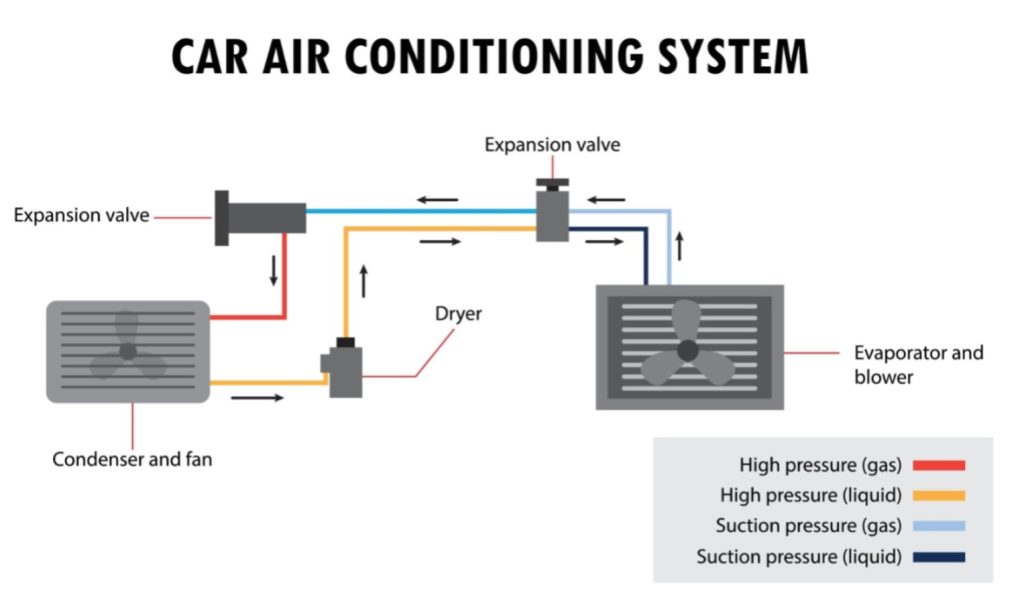
Air conditioning does not create cold. It moves heat from inside the cabin to outside the car, using refrigerant that changes between liquid and gas to carry that heat along with it.
- Compressor. Pressurises the refrigerant and drives the cycle. Critically, the oil that lubricates it circulates with the refrigerant, which is why running a system low on charge damages the compressor rather than merely making it less effective.
- Condenser. Sits at the front of the vehicle, ahead of the radiator, shedding heat to outside air. Desert dust and debris pack into its fins, and a blocked condenser is a common cause of poor cooling in traffic.
- Expansion valve or orifice tube. Meters refrigerant into the evaporator. A clog here stops cooling outright.
- Evaporator. Inside the dashboard, absorbing heat from cabin air. Also where condensation forms and where musty smells originate.
- Refrigerant. The heat-carrying medium, and the key point: it is not consumed. A sealed system holds its charge. If yours is low, refrigerant has escaped somewhere, and that somewhere is the actual repair.

Why A/C Is Not a Luxury in Phoenix
Cabin temperatures in a car parked in the Phoenix sun climb far above ambient, and heat affects reaction time, patience, and judgement before most people notice it is affecting anything. Children, older passengers, and pets are at real risk in a vehicle that cannot cool.
There is a second function people forget. The A/C system is also your defroster, because it dries the air before it reaches the windscreen. That is why the compressor engages when you select defrost even in winter, and why a dead A/C system means slower defogging on the handful of cold, damp mornings the Valley does get.
Seven Signs Your A/C Needs Attention
Any one of these is worth a diagnosis. Several together make it very likely.
- Air that is cool but not cold. Especially if it used to be colder. Gradual decline usually means a slow leak.
- Cooling that fades as the day heats up. Cold in the morning, poor by mid afternoon. A common pattern with low charge, a struggling condenser, or a cooling fan that is not running when it should.
- Weak airflow regardless of temperature. If the air is cold but there is not much of it, the problem is usually the cabin air filter or the blower rather than the refrigerant side.
- Cooling that comes and goes. Frequently the compressor clutch cycling irregularly, or an electrical fault.
- Noise when the A/C engages. Clicking, squealing, grinding, or rattling that appears when you switch it on and stops when you switch it off.
- Odour from the vents. A musty smell usually means microbial growth on the evaporator or a loaded cabin filter. A sharp chemical or sweet smell is different, and worth investigating promptly.
- Oily residue around A/C fittings or lines. Refrigerant carries oil, so a leak often leaves an oily film that collects dust right at the leak point. This is a genuine symptom, unlike clear water.
The Water Under Your Car Is Not a Leak
This distinction matters, because it causes needless worry every summer and it is the opposite of a warning sign.
Your evaporator is cold, Phoenix air holds moisture, and moisture condenses on cold surfaces. That condensate drains out through a tube under the vehicle. A clear puddle under the passenger side after running the A/C on a hot day is the system working exactly as designed.
When it does matter is when that drain tube clogs. The water then backs up and ends up on the passenger floor instead of on the ground. Damp carpet on the passenger side with no puddle underneath is the actual symptom to act on. Coloured or oily fluid is a different matter entirely, and is not condensate.
Why a Recharge Alone Is Usually Not a Repair
This is the most useful thing on this page, and the thing most often done backwards.
A recharge on a leaking system will blow cold for a while. Then the refrigerant escapes again, the cooling fades, and you are back where you started, having paid for refrigerant that is now in the atmosphere. Repeat that over a few summers and you have spent more than the leak repair would have cost, with a compressor that has been running short of oil the entire time.
Proper diagnosis means finding where it is going, using pressure testing, dye tracing, or electronic leak detection, and fixing that. Sometimes the answer is genuinely a small service. Sometimes it is a hose, a seal, a condenser, or an evaporator. What it is not is refrigerant you top up every spring as routine maintenance.
One thing worth knowing before you assume an A/C service is a small job: vehicles from roughly the mid 2010s onward use R-1234yf refrigerant rather than the older R-134a. It requires different equipment and costs substantially more per pound.
Why Stop Leak Cans Cause Problems
Parts store cans are tempting, and they are the fastest way to turn a repairable system into a complicated one.
Without gauges there is no way to know the actual charge, and overcharging cools worse than undercharging while putting the compressor at risk. Many of those cans also contain stop leak sealant, which migrates through the system and contaminates components. Shops will frequently refuse to connect recovery equipment to a system that has had sealant in it, because it damages machines that cost more than the repair does.
And the underlying point remains. If the system is low, something is leaking. Adding more refrigerant does not address that.
What the Repair Involves
We start by confirming what is actually wrong, because weak cooling and weak airflow are different problems with different fixes and they get confused constantly. We check refrigerant pressures, compressor and clutch operation, condenser condition, cooling fan function, cabin filter and blower, and the electrical controls.
If refrigerant is low, we find the leak rather than simply refilling it. Once repaired, the system is evacuated and recharged to the manufacturer’s specified weight, not by guesswork, and then tested under load to confirm vent temperatures hold up in real heat.
You get the estimate in writing before we start. If the fix turns out to be a cabin air filter rather than an A/C repair, that is what we will tell you.
Preventive Care That Genuinely Helps
- Run the A/C briefly year round. A few minutes every week or two keeps seals lubricated and the compressor circulating oil. Systems that sit unused develop leaks at dried out seals.
- Keep the cabin air filter fresh. Desert dust loads these fast, and a clogged filter makes the blower work harder to deliver less air. It is frequently mistaken for an A/C fault.
- Rinse the condenser. It sits at the very front of the vehicle collecting dust, bugs, and road debris. Gently clearing it improves cooling in traffic, where airflow is already scarce.
- Park in shade or use a sunshade. A cooler starting cabin means the system is not fighting a superheated dashboard for the first ten minutes of every trip.
- Book service in spring, not July. March and April are the sensible months to find a leak. Everyone else discovers their A/C problem in the same week of June.
Frequently Asked Questions
Why is water dripping under my car after running the A/C?
That is condensate, and it is normal. The evaporator is cold, humid air passes over it, and the resulting water drains out through a tube under the vehicle. Clear water under the passenger side on a hot day means the system is working. What is not normal is damp carpet on the passenger floor with no puddle outside, which usually means the drain is blocked and the water is going inside instead.
Can I just add refrigerant from a can myself?
We would not recommend it. Without gauges there is no way to know the actual charge, and overcharging cools worse than undercharging and can damage the compressor. Many of those cans also contain stop leak sealant, which contaminates the system and the recovery equipment used to service it, and some shops will refuse to work on a system that has had it. If the system is low, something is leaking, and adding more does not address that.
Why does my A/C work in the morning but not in the afternoon?
Several things produce that pattern. Low refrigerant charge is common, because a marginal system copes at lower ambient temperatures and cannot when it gets hot. A blocked condenser or a cooling fan that is not running properly does the same, since both leave the system unable to shed heat when it matters most. It is a real symptom and worth diagnosing rather than accepting.
How often does a car A/C system need recharging?
It should not need recharging on a schedule at all. A sealed system holds its charge, so a system that needs topping up every year has a leak. Annual inspection is worthwhile in this climate. Annual recharging is a sign that something has not been fixed.
My A/C blows cold but there is barely any air. What is wrong?
If the air is genuinely cold, the refrigerant side is probably fine and the restriction is on the airflow side. A clogged cabin air filter is the most common cause here, particularly with our dust, and a failing blower motor or resistor is the next. Both are usually far less involved than a refrigerant repair.
Get Your A/C Diagnosed in Phoenix
If your A/C has faded, quits in the afternoon, or has been recharged before and gone warm again, bring it in, ideally in spring rather than in the middle of a July heatwave. Our ASE certified technicians will find where the refrigerant is actually going instead of topping it up and sending you off.
Pete Kelley’s Auto Service has been on North Central Avenue since 1972. We use quality NAPA parts on every job and stand behind the work.
Pete Kelley’s Auto Service
9328 N Central Ave, Phoenix, AZ 85020
Monday through Friday, 7:30am to 5:30pm
Call or stop by. We will find the leak and get you cold air again before summer does its worst.